Why I’m learning to love chaos
01/03/2026 at 2:32 am | Posted in Wellbeing notes | Leave a commentTags: creativity, inspiration, life skills, mindfulness, writing inspiration
It was one of those mornings. Nothing was going to plan. I was supposed to be having a quiet cup of coffee at my place with a friend. Instead, it was as if I’d put a sign on the door inviting everyone in. A stream of random visitors turned up, including the window cleaner, a slightly lost horse and sundry builders. My dog was beside himself. Chaos ensued.
After all the visitors had left, the air felt unexpectedly fresh and clear, as though a storm had blown through – as though all the loose branches and detritis of the neighbourhood had been swept away. It occurred to me then that chaos can actually serve a purpose, of sorts. Although my morning had not gone as planned, I was buzzing with fresh ideas for my writing. The mayhem had somehow cleared away a mental stagnation that I hadn’t even been aware of.
Chaos is a fact of life. By definition, we can’t control it, or even predict when it’ll come our way. But it seems that we can survive and possibly thrive when chaos suddenly appears. So, next time your plans collapse, why not embrace the feeling of not being fully in control? Whisper a welcome to Storm Chaos. Put aside your ‘to do’ list and open your mind to new possibilities. Remind yourself that mayhem never sticks around for ever. And the peace that follows can truly be appreciated.
Fiction notes: These two aspects of character
15/09/2023 at 7:40 am | Posted in Fiction notes | 3 CommentsTags: character development, fiction writing, journalling, writing exercise, writing inspiration

Recently my mother rediscovered my old school journal, from when I was eight years old. Of course I was a bookworm then! It seems I’ve been a bibliophile all through my life.
Reading, for me, has alway gone hand in hand with writing – with the telling of stories; with the creation of fictional characters. This extract from my journal reveals, I believe, the essential stability of character. In certain, fundamental aspects I have not changed one iota from when I was eight. I’m still fascinated by stories, still intrigued by the way an author from past times can reveal truths that seem freshly relevant today.
Of course, I’m not exactly the same as when I was eight. Life has intervened. Countless events have acted on me like ocean waves over a pebble, shaping me differently to how I began.
In writing a novel, those twin aspects of character are both worth searching for, I believe. Which aspects of a person are fundamental… and how then are those aspects shaped by circumstance?
Writing exercise
Create a journal entry for your character, aged eight. At the top of the page, write ‘Hobbies’. Then write whatever comes to mind. What was your character’s main hobby when they were little? What does that reveal about them today?
Fiction notes: Can writing by hand improve a novel?
15/06/2023 at 4:06 pm | Posted in Fiction notes | 3 CommentsTags: creativity, fiction, fountain pens, writing fiction, writing inspiration
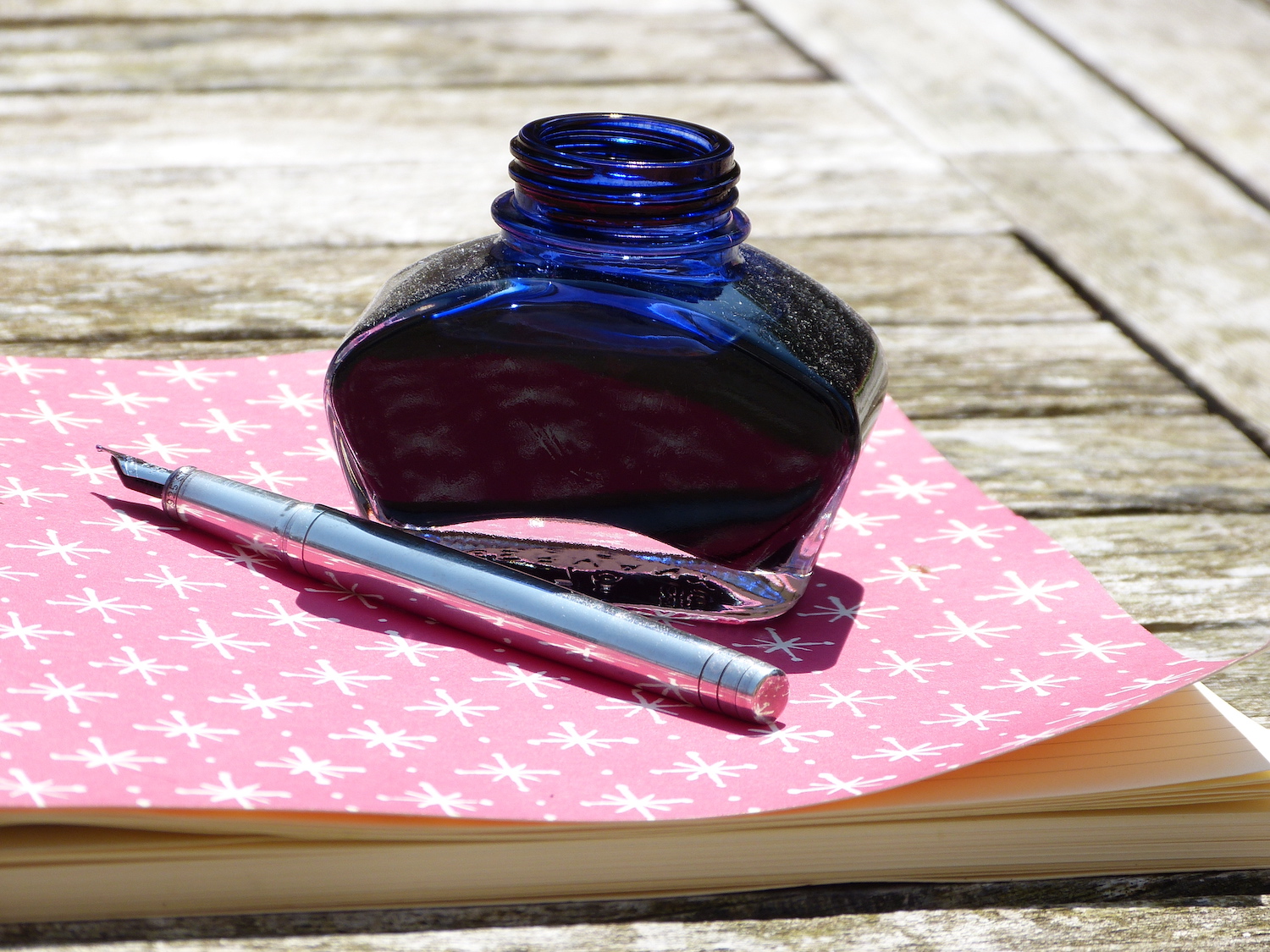
The scratch of pen against paper, and the flow of midnight ink. A rustle of turning pages, and the feel of a notebook against skin… When we write by hand, our senses get involved. It’s a tactile experience, involving texture and sound and even the evocative scent of the writing materials.
Contemporary authors have been known to write by hand. JK Rowling, for example, scrawled Harry Potter and the Philosopher’s Stone in notebooks in an Edinburgh café; Stephen King wrote Dreamcatcher by hand as a sort of pain-reducing therapy while recovering from a serious car accident; and Neil Gaiman hand-wrote Stardust, to help him to feel closer to that novel’s Victorian setting. All three novelists have continued to put literal pen to paper in later works, and they all use fountain pens to do so.
Why would any author opt for the relative messiness of an ink pot? Using a keyboard is generally much faster; you can move words around every which way in a document, and of course you don’t end up with ink-stained fingers. But tapping onto a keyboard does not please the senses in quite the same way. It seems that the extra effort involved in handwriting helps our brains to work differently, and that can be useful.
I have yet to write a full-length book by hand. Maybe, one day, I will. However, for every work in progress, I do keep a daily notebook. The jottings in it – about plot, and character, and dialogue that comes to me willy-nilly at any time of day and night – are hugely useful. They’re helpful for the creative process, and they bring contentment. When the nib touches paper, and the ink flows, I’m convinced that ideas flow too, in sensory and meditative ways.
How about you? Do you ever write by hand? And have you penned, or would you pen, an entire book by hand, inky fingers and all?
Fiction notes: The power of juxtaposition
15/04/2023 at 10:53 am | Posted in Fiction notes, Uncategorized | 2 CommentsTags: creative writing, short stories, writing fiction, writing inspiration, writing techniques

For decades, I wrote non-fiction. Then the poles shifted in my personal life, and now I almost always write fiction. But back in the beginning of my career, I did write a single short story. It was called ‘The Dormer Window’, even though the window in the story was a slanting, attic sort that could be more properly termed a skylight.
When it was published, in Britain and Ireland, no one seemed to mind the architectural inaccuracy. What they liked was the way it juxtaposed the hard drudge of a couple’s ordinary life with a window that revealed their passions and dreams, in unexpected ways. In the story, the husband created an attic bedroom, complete with slanted window above the bed. At night, their reflection revealed them as Chagall’s lovers, entwined and floating in the air. As one editor memorably put it, “It’s about love and DIY”.
I had a quick look for the story yesterday, but couldn’t find it. If I do, I’ll share it on these pages.
But what I really want to talk about is the use of juxtaposition in fiction writing. It’s such a useful device, to put two contrasting things closely together. And it seems to work particularly well for people. To be human is to have duties that we must do, to survive and hopefully thrive. But to be human is also to have powerful emotions. In day to day life we often try to hide these. However, it’s vital for our sanity that there is an outlet for our yearnings, hopes and dreams – a dormer window, if you will.
I invite you to consider what you are currently writing, or perhaps reading. Is juxtaposition present? And, if so, how does it enhance the story?
Fiction notes: Who’s telling the story?
15/02/2023 at 8:55 am | Posted in Uncategorized | Leave a commentTags: art of the novel, fiction, POV, romantic fiction, romantic novels, writing inspiration, writing techniques

Novels written in the first person have a certain power. When I read, “I am a free human being with an independent will,” in Charlotte Brontë’s Jane Eyre, for example, I’m owning that thought. In my imagination, I am Jane.
Now consider these words further along in the same novel: “Reader, I married him”. That’s such a satisfying line – an emotional closure to a handkerchief-drenching plot. But Jane is now addressing the reader… and I am the reader, so therefore I can no longer imagine that I am Jane. So I slip into the role of confidante, which is nearly as good, but not quite. And yet the switch is worth it for the power of that line.
By addressing the reader directly, Charlotte Brontë breaks the fourth wall – she reminds us that Jane Eyre is a fictional character on a metaphorical stage. The stage, with its back and two sides, may resemble a four-walled room. But that illusion dissolves as soon as the audience is acknowledged.
Luckily, the reader’s imagination is elastic, as long as the storytelling is strong enough to support it. I’m quite happy to identify as Jane Eyre for the duration of the novel, except during those times when she addresses me.
If a novel is narrated in the third person, do we identify less with the central character? Logic suggests that we might. And yet consider Jane Austen’s Persuasion. My all-time favourite novel is narrated in the third person. However, Persuasion is stuffed full of dialogue, and possibly the best love note in the English language. There is therefore lots of first-hand experience to read and to enjoy.
What about you? Do you like a character to narrate her own story? And how does it feel to you if she talks directly to the reader?
Fiction notes: Why Muscles Do Not Make a Man
15/01/2023 at 9:30 am | Posted in Uncategorized | 4 CommentsTags: a question of attraction, am writing, love interest, romances, romantic heroes, romantic novels, writing inspiration, Writing prompts

It is a truth universally acknowledged that when Woman meets potential Mate, one of the things she probably will notice is his muscles (or lack of them). In primal times, it mattered, of course, that a partner would be strong enough to help protect your future children. But does this matter today, in romantic fiction or, indeed, in life?
I have a dog who is stronger than me. Yet he looks to me, and to the other humans in the household, for affection, food and shelter. His physical strength is trumped by his need to be part of the pack. In our human world, the patriarchy became dominant by building on the advantages of muscular strength. But physicality has its limitations. Intelligence, collaboration, adaptability, inventiveness and agility are all useful attributes for a potential mate of any gender.
In fiction, it can be fun to combine different strengths in one delicious package. Think of Superman, the nerdy, bespectacled reporter, with muscles that can save countless others. Or the popular trope of the sexy librarian, in glasses. Glasses are a quick way to suggest intelligence, but maybe there are other descriptors that can work in less expected ways?
The male love interest in my current writing has a healthy, toned body and not, so far, any sign of glasses. But his most attractive quality has nothing at all to do with muscles, although he does use his strength to protect. So what exactly is this man’s mysterious appeal? Well, here’s the thing. He’s kind. And kindness can be the sexiest quality of all. (Though he does have to learn that, sometimes, you have to be cruel to be kind.)
So, what characteristics do you like to see in a hero – or a potential mate? I’d love to hear your thoughts.
Illustration: Self portrait by Philipp Otto Runge, Public domain, via Wikimedia Commons
Website Built with WordPress.com.
Entries and comments feeds.
 Suzanne Askham