We’re meditating on discovery
22/02/2015 at 4:16 pm | Posted in Uncategorized | 2 CommentsTags: gratitude, Guidance, inspiration, meditation, Mind body spirit, mindfulness, poetry

The word we’re meditating on this week is ‘Discovery’.
When we regularly sit down in quietness and allow the busy thoughts of our mind to subside, a clarity can emerge which spreads into every aspect of our life. We see things as though they are lit from the inside. We gain insights. This process of looking at the familiar and seeing it afresh is one of the best forms of discovery, and one of meditation’s great gifts.
The following is an example from this morning, when I simply looked out of a window, saw cars in the far distance, and understood on a deeper level that each vehicle contained a shining soul.
What discoveries will come your way today?
The Road to Calne
Shining beads glide
between fields of frost
under the rosy sky
of our potential.
~~~
Each bead, a soul
hiding from its light,
disturbed by the future,
wounded from the past.
~~~
If we dare see
how brightly we glow,
our heavy cloaks of fear
dissolve in the warmth.
The thing about gates
11/02/2015 at 9:35 pm | Posted in Uncategorized | 3 CommentsTags: Guidance, life skills, meditation, Mind body spirit, mindfulness, self-awareness
This week, in the studio, we’re meditating on the word ‘gateway’. And the thing we discovered on Monday is that there is no such thing as a half-open gate, not really. In the fields around the studio, a gate is either unlatched and open:

Or it’s latched and closed:

An unlatched gate in the country is designed to swing wide open. Cattle, sheep and people walk through. There are no half-measures. The gate is never just a little bit open. If it’s open, it’s open.
It all comes down to the latch.
When we are not living mindfully, we can kid ourselves that a gate along our own life path is open when it isn’t really. And because it isn’t really open, we never quite seem to get the job we want, or the partner, or the professional awards. We get frustrated, and can’t understand why we don’t progress.
Sitting quietly in meditation can help us to recognise that we haven’t actually lifted the latch and opened the gate to new opportunities along our path. We can also see the reason: we’re reluctant to leave the past; or we’re nervous about the future.
When we become aware of our conflicting emotions about progress, we can see more clearly how our own actions are keeping the latch closed. And then, we can mindfully choose to open the latch and walk through into the future.
Conversely, sometimes our boundaries are wide open. When that happens, we feel tugged by conflicting external demands; we don’t have enough rest time, or privacy. It can be useful then to sit quietly in meditation and tune into that gate latch once more. Why have we left the gate hanging wide open? What would happen if we closed the gate at least some of the time? That would mean saying ‘no’ to people. It would mean scheduling time in our diary for us. That would be a good feeling.
Intuitive mindfulness is a match made in heaven
03/01/2015 at 1:06 pm | Posted in Uncategorized | Leave a commentTags: Guidance, Intuition, meditation, Mind body spirit, mindfulness, peace, Spirituality, wellbeing
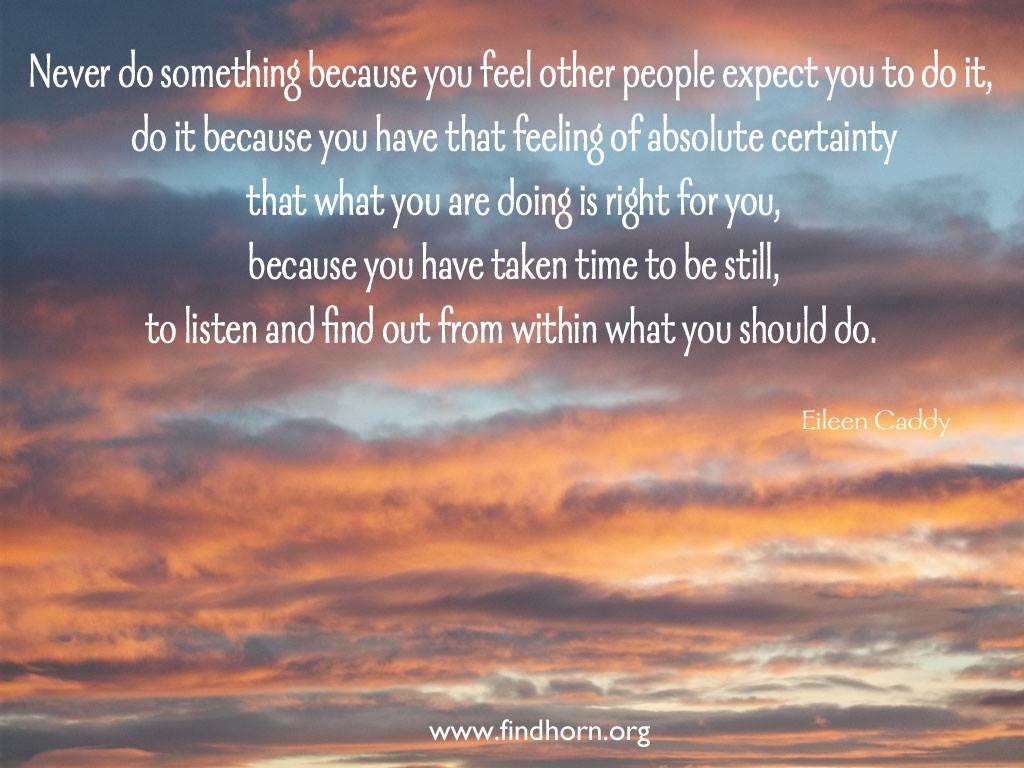
“Never do something because you feel other people expect you to do it, do it because you have that feeling of absolute certainty that what you are doing is right for you, because you have taken the time to be still, to listen and find out from within what you should do.”
The words are by Eileen Caddy, co-founder of the the Findhorn Foundation in Scotland. The poster here is shared with thanks to that spiritual community. Eileen Caddy’s book of inspirational writings, Opening Doors Within, was a major influence on me when I first thought about running meditation workshops in a Wiltshire studio.
The principle of noticing what you notice is central to mindfulness. When we are mindful, we focus on our breath, our pulse, the position of our body, the feel of the chair beneath us, the temperature of the air entering and leaving us, and so on. We notice what we are doing in the present moment, without rushing on to the future, or dwelling in the past.
When we mindfully wash dishes at a sink, for example, we take our time noticing the rainbow colours in the detergent bubbles, the feel of water against the surface of our hands, the sound and movement of dishes within a bowl of warm water.
As Thich Nhat Hanh teaches through his many writings on mindfulness, when we are fully present, we experience peace.
What is less widely talked about is that when we are mindfully present, we allow the quiet inner voice of our intuition to be heard. This is what Eileen Caddy understood fully, and Findhorn still encourages this in myriad ways today.
Noticing what you notice is an integral part of receiving intuitive guidance. Being mindful is essential if we want to understand what we truly feel, and the direction that we fundamentally wish to go.
Three guidelines for any group
07/12/2014 at 8:54 pm | Posted in Uncategorized | 1 CommentTags: Guidance, inspiration, life skills, meditation, Mind body spirit, Spirituality

These guidelines came to me a few years ago from Pierre Pradevand, author of The Gentle Art of Blessing. It was the start of a delightful weekend retreat in Derbyshire. I’m sure his three peaceful rules enhanced the atmosphere. Ever since, I have shared the guidelines with those who meditate with me, two or three times a week, in Wiltshire. Now seems a good time to share them here. They apply to any group situation.
1) Listen without judgement, in a supportive and caring way.
2) Respect confidentiality. If someone is telling you something of a sensitive nature, keep it to yourself, understand that this is a privileged moment. Do not talk about it later to others.
3) Own your own experience. Say, “I feel”, rather than “You feel”. It’s surprising how often we cut ourselves off from our own emotions by describing them as though they belong to the listener, rather than the talker.
Here is an example of the third guideline:
“When your children leave home, you feel sad,” says one speaker.
“When my children left home, I felt sad,” says another.
Can you feel how much more powerful and authentic the second sentence is? It’s also easier to empathise with the second speaker.
When we own our own experience, respect confidentiality, and listen in a supportive way without judgement, our corner of the world becomes infinitely more peaceful.
Website Built with WordPress.com.
Entries and comments feeds.
 Suzanne Askham