Guidance is simpler than you think
30/10/2018 at 6:55 pm | Posted in Uncategorized | 2 CommentsTags: energy healing, Guidance, healing, inspiration, parenting, special parenting

Twenty years ago, I was struggling with the challenge of parenting a baby with complex health issues. I was also, by no coincidence at all, starting off on my long path to be an energy therapist. In the night, I would dream vividly. The dreams were detailed, emphatic and helpful. I called them ‘Night tuition’. I saw them as a form of guidance. Where they came from, I had no idea. To me, it didn’t matter whether they originated from my own subconscious, or from some infinite dream library to which all beings have access.
What mattered most to me is that, over time, the dreams helped me to navigate the tricky path that I was treading, along with my partner and our tiny, so vulnerable child.
I’d like to share with you the simplest, barest dream that I experienced. It was simple, but it was powerful. It set the tone for all my future parenting. Actually, it set the tone for everything that has happened since, in every single aspect of my life.
In the dream there was just one, single thing to look at: a rectangle. The shape was shown against a plain background. The rectangle and the background were both devoid of colour. The whole scene was greyscale – just varying degrees of light and dark.
“Which is lighter: the rectangle, or the background?” asked a teacher, next to me but invisible.
I looked carefully. It felt for all the world like some kind of eye test.
Truthfully, the rectangle and the background seemed at first to be pretty similar shades of grey. However, as I looked, it seemed to me that the rectangle was shining more brightly. In fact, it was definitely lighter.
“The rectangle,” I replied.
“Good,” said my teacher. And waves of love washed over me.
In that instant, I understood that the rectangle represented a choice that each of us makes countless times. The rectangle represented the choice between love and fear. Love, in this dream example, was lit up, as though a light was shining through it. If I had seen the rectangle as darker than its background, it would have meant that I was viewing life through a fearful lens, programmed to expect the worst. However, by seeing the rectangle as lighter than its background, I was actually viewing life through the lens of love. It meant that on some fundamental level, I had learnt to trust that in the big scheme of things, all is well.
This was an important lesson for me. It helped me to understand that my love as a mother could be a powerful force in my son’s life. It enabled me to see that my partner’s love as a father could be as protective as mountains. And it taught me that fear would weaken that parental strength and power. So the dream reinforced my innate wish to choose love rather than fear.
How to improve your focus in meditation – and life
16/08/2018 at 5:59 pm | Posted in Uncategorized | 3 CommentsTags: healing, inspiration, life skills, meditation, mindfulness, owl, reflections

What is your relationship with Focus? Have you been together a while? Was Focus a first love, or are you and Focus perhaps not even talking?
If I were a life coach, I might suggest that you feed your focus and starve your distractions. Or I might say, “What you focus on is what you get more of.”
However, I am not a life coach. In the spheres of wellbeing in which I move, focus is not an end goal. It’s an invitation to be fully present. All we can ever have is this present moment, but it’s enough, because it’s everything. If we witness this moment fully, it has the magical ability to open up like a fractal. Rather like the owl I met recently, we develop the ability to see, hear and sense in ever more detail.
The state of focusing is a relaxed, alert way of being. We become aware and awake to what’s around us. Importantly, we don’t focus on what we don’t have. We focus on what is. In so doing, we realise how very much is contained within the present moment. We can then make choices based on our expanded awareness, which can help us step into an optimum future.
What is your relationship with Focus? Are you perhaps close friends? Maybe, just maybe, Focus is your life-long guide and companion?
This is the perfect time for your self care
12/02/2018 at 6:29 pm | Posted in Uncategorized | 2 CommentsTags: inspiration, Lent, mindfulness, personal development, reflections, self-care, Spirituality

Valentine’s Day and the first day of Lent coincide this year. The resulting fusion of love and abstinence from a selected item of food or drink makes this the perfect time to focus on self care.
How might you care for yourself for the 40 or more days of Lent, which begins this Wednesday 14th February?
One year ago, inspired by my friend Sarah Sexton, I gave up refined sugar for Lent. After Lent I continued the practice. I’m happy to say I am now 10 kg lighter, and back within a healthy weight range. Along the way I lost my sugar cravings, and the associated swings between high energy and tiredness.
Lent is a perfect time for self-reflection. On a scale of 1 to 10, how well are you currently caring for your body? What single act of food-abstinence will your body most benefit from?
Whatever your spirituality or lack thereof, approaching Lent as an act of self care is an invitation to thrive.
What Westerners can learn from Eastern meditation
13/06/2017 at 10:00 am | Posted in Uncategorized | 4 CommentsTags: dhyana, inspiration, learning, meditation, mindfulness, reflections, relaxation, serenity, Spirituality, waterlily
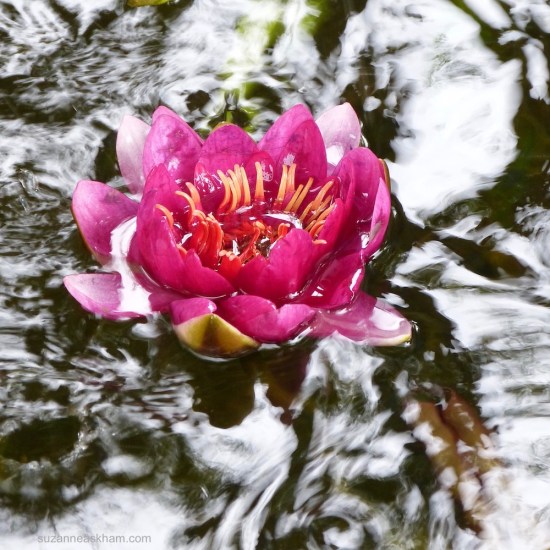
When meditation goes well, it’s brilliant. Blissful. Calming. However many beginners struggle to reach that point. They talk about ‘failing’ and ‘not being able to meditate’, as though it’s an exam they’ve somehow flunked.
I’ve heard this despondent comment many times over the nine years that I’ve been running meditation groups in the UK. When newcomers turn up, they often say, “I can’t meditate, but I want to try and give it another go”. Or “I tried meditation once before, and I couldn’t do it.”
And, of course, I regularly meet people who wouldn’t go anywhere near a meditation group, believing that they are doomed to failure so it’s not even worth trying. But there’s something wistful in the way they tell me this. It’s as if they suspect they’re missing something, and they just don’t know what to do about it.
There is an interesting reason why Westerners may sometimes find it more difficult to meditate than their Eastern counterparts. It all comes down to the name itself: ‘meditation’. Or, to be exact, the origins of the name.
The Western approach
We can trace the verb ‘to meditate’ back to Latin. It meant: to ponder, reflect, consider, devise. In the old European languages it also meant: ‘to measure’, ‘to judge’, ‘to protect’, ‘to provide for’ and ‘to deliberate’. Go further back in time, to the original ‘seed’ language that early humanity shared, and it meant ‘to take appropriate measures’, ‘to give advice’ and ‘to heal’. This was the Proto-Indo-European (PIE) seed word, ‘med’, which also evolved into ‘mediate’ and medicine among other words.
The historical Western approach to meditation is therefore driven by a well-intentioned desire for results: the solving of a problem, the righting of a wrong, the mending of an ill.
The Eastern approach
In the East, the Sanskrit for meditation is ‘dhyana’. Other Eastern languages have variants on this. The PIE seed word for dhyana is ‘dheie’ meaning ‘to see, to look’. The word ‘Zen’, signifying an aspect of Buddhism with a deeply contemplative approach to life, shares the same seed word.
So in the East, ‘dhyana’ is the practice of simply being, simply witnessing without judgement.
Western meditators broadly follow the Eastern tradition. We sit in silence, simply being… but we also have a cultural legacy which whispers to us that we need to get results from our quiet time.
A happy fusion
Of course, we can’t really divide the world into neat East-West packages. Wherever you live, whatever your origins, you’re pretty well guaranteed to experience the ‘monkey chatter’ of your mind during meditation. And this can do a great job of distracting you with wide-ranging thoughts.
But your approach to the monkey chatter can make the difference between frustration and happiness during your practice – and that’s where an awareness of meditation’s ancient definitions can be helpful.
If we accept that we have chosen to sit in silence, focusing on a particular word, or concept, or image, or sound, simply to witness without trying to change anything, then we are much more likely to enjoy our meditation sessions. Each time we notice that our thoughts have strayed, we calmly remind ourselves that we are here to meditate, and we return to our point of focus.
No judgement. Just practice.
To summarise, we meditate simply to meditate. There is no end result we are looking for. So we cannot ‘fail’. We are simply being conscious witnesses of the moment.
And yet, when we make a regular practice of meditating in this way, with no expectation of reward, the insights and inspiration do come. Meditation focuses and refreshes the mind like nothing else.
So if you really struggle to meditate, take heart. You are not alone. Now that you know the ancient secret buried in the very name of meditation, you can choose to let go of the striving and, instead, embrace the serenity.
How to transform your relationships with one fascinating word
05/06/2017 at 10:04 am | Posted in Uncategorized | 2 CommentsTags: energy healing, healing, inspiration, intuitive development, meditation, peace, Relationships, spiritual healing, wisdom
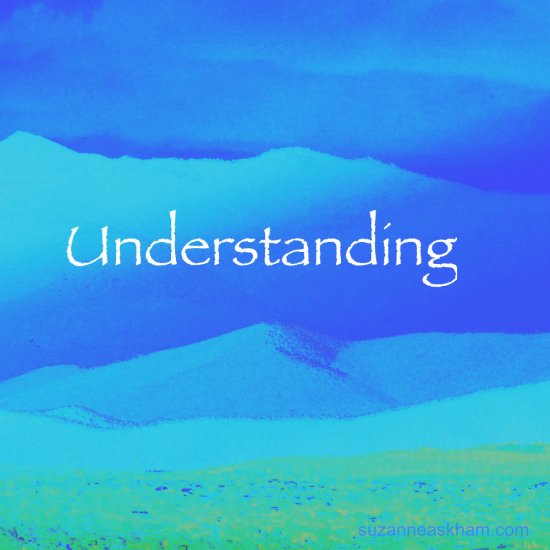
Understanding blends knowledge with kindness. When you apply understanding to a relationship, conflicts crumble. Dynamics alter. Ego gives way to empathy.
An understanding person comprehends something or someone with compassion. They hold a cup of knowledge that contains kindness and love as well as wisdom and perception.
Understanding can strengthen a floundering relationship. If a partnership is ending, it can enable that to happen with love rather than anger. Understanding can also be a wonderful doorway to laughter and humour which in themselves can heal relationships.
Understanding is our meditation word in the Studio this week.
How could applying this word alter a challenging situation for you?
Aquamarine bliss
14/11/2016 at 5:18 pm | Posted in Uncategorized | Leave a commentTags: healing, Health, inspiration, meditation, nature
The theme this week in my studio is ‘Aquamarine’. I invite you to focus on the beautiful green-blue colour of the sea. You know, the way it looks when waves rise up and daylight filters through the water…

Here is a wellbeing exercise for you. Imagine you are made up entirely of this sea-glass colour. These pictures taken at Surfer’s Point in Western Australia may help you.
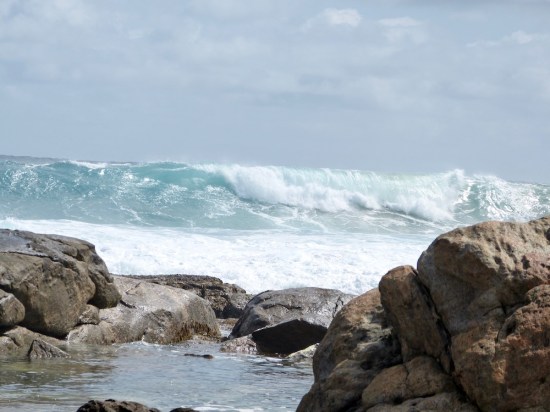
Visualise that any areas of pain or illness in your body are being washed away by the cleansing aquamarine light. Picture your body becoming more and more like aquamarine sea glass, as if lit from within. You might imagine that areas of pain are dark and dense, or sticky and gluey. As the water keeps washing through, these become dislodged until the whole of you is simply aquamarine: healthy; radiating with good health, and speaking with your own authentic voice. Enjoy the feeling!

Breathe your mantra
31/10/2016 at 9:45 am | Posted in Uncategorized | Leave a commentTags: inspiration, meditation
This is
a meditation
an exercise
Easy, but not quick
Breathe in “I am”
Breathe out “mantra”
Repeat
for twenty minutes
maybe thirty
Set a timer
so you don’t need
to worry about time
When you witness
your mind wandering
return to your
silent words
I am mantra
I am mantra
I am mantra
After a while
if you’re lucky
your mind will
offer up the mantra
that runs through
your core
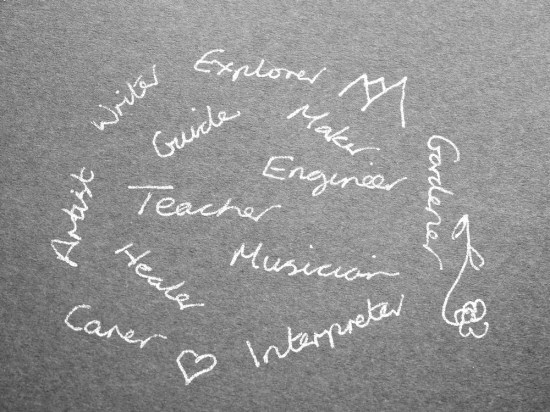
Are you teacher
healer, artist
explorer, engineer?
Are you carer
cook, musician
maker, even mystic?
Listen to the mantra
at your core
Don’t try to change it
Accept it, embrace it
I am mantra
I am mantra
That is all
What an ice mountain can tell you
30/07/2016 at 8:52 pm | Posted in Uncategorized | 1 CommentTags: Guidance, healing, insight, inspiration, meditation, nature, personal development, sacred site, travel
Some places feel special, in ways we don’t fully understand. One such I visited recently is Snaefellsjokull. This ice-capped volcanic mountain rises from a remote Western peninsula in Iceland. Its name translates as ‘Snow-fell glacier’.

Perhaps it feels remarkable because of the near-Arctic juxtaposition of ancient fire and eternal ice, enhanced by the mystery of ocean clouds.
Or maybe it’s because the myriad volcanic peaks in this region take on their own fierce presence in a stark landscape created by the slow separation of two major continental plates.

On the slopes of the glacier itself, the sense of presence grows stronger, along with a distinct chill. It’s easy to see why Jules Verne chose Snaefellsjokull as the entrance to the earth’s core in his novel, Journey to the Centre of the Earth.
There’s a purity and absolute freshness to the air, as though all human preconceptions have been frozen or blasted away.

The ancient volcano brings gifts to the watchful. My daughter found a piece of obsidian – black fire glass. And I discovered what I fancied to be the subtle, changing image of a fire sprite on a smooth piece of basalt.
Snaefellsjokull is said to be one of the sacred centres of the earth, a portal to other realms.

Standing on the glacier, it’s possible to see things differently… to recognise the true landscape of our own lives.

An ice mountain can tell you much about yourself.
Each of us carries within us the qualities of Snaefellsjokull: the ice and fire, the mystery and the deep, all held within a shimmering equilibrium that is subject to disruption when inner or outer forces overturn the state of balance.
Witnessing this in nature is to witness it in ourselves. We can open up to these qualities, and allow them to flow through the meridians, our own subtle energy channels.
There are four burning questions an ice mountain draws out of us:
• What in you is ready to be expressed?
• Look deeper now. What are you suppressing?
• Do you always recognise your own inner promptings towards action?
• And, above all, do you honour the passions and visions that ignite you?
Take time to answer these questions. They are a recipe for life-long wellbeing.

Breathing mindfully the ocean way
08/04/2016 at 6:04 pm | Posted in Uncategorized | Leave a commentTags: Guidance, happiness, inspiration, meditation, mindfulness, nature, wellbeing

I stood on a bumpy shore in Galway, Ireland and breathed in salty cool Atlantic air. Suddenly, my lungs were filled with fresh ocean breezes. Each in-breath came with an excitement of Atlantic energy. Each out-breath took with it a thousand everyday stresses.
In a situation like that, you can’t help but be fully present. My mind wasn’t about to wander, because the experience was so vivid.
All my senses were engaged with savouring this moment. I could taste the salt in the air, feel the wind speed-weaving my hair into maritime knots, see the sunlight dancing through fast moving clouds, breathe in the tangy scent of seaweed, and hear the waves lapping against pebbles. Additionally, the wind was chilling!
The challenge is to breathe equally mindfully in familiar situations – in our everyday life. In fact, this is one of the very best meditations to practise regularly. Simply sit in silence once a day – first thing in the morning is perfect – and focus on your breathing for 20 minutes or so. And notice what you notice.
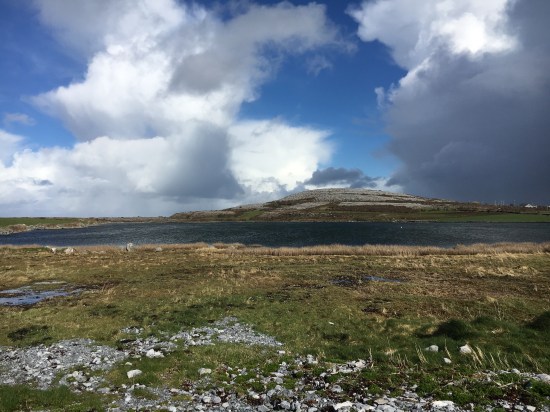
Here are three techniques that can be helpful.
1. Treat every mindful breathing session as though it’s the first time. You are a traveller, newly arrived at this shoreline of your breathing. Witness the air entering you as though it’s the most amazing newcomer in your life. Witness it leaving you like the life-long friend it is.
2. Focus on a particular point: such as the nostrils, the lungs or the abdomen. Notice the sensation of the air as it enters and leaves you. Witness how your muscles expand and contract rhythmically. Mindfulness pioneer Jon Kabat-Zinn suggests focusing on the belly, and likens it to the deeper, slower moving currents of the ocean: “When we focus on our breathing down in the belly,” he writes in Full Catastrophe Living, “we are tuning into a region of the body that is far from the head and thus far below the agitations of our thinking mind. It is intrinsically calmer.”
3. At intervals during your day, whenever you remember to, briefly observe your breathing. When you next feel stressed, make a point of noticing what is happening to your breath. Focus on the belly, as it rises with the in-breath and falls with the out-breath. Sometimes this movement is subtle. In the time you take to witness it, the stress or surface agitation has often lessened. It’s as if that pause creates a tiny gap in the stressfully woven fabric of your life, and loosens every thing up so new options can emerge.
How to visualise during meditation
27/01/2016 at 6:44 pm | Posted in Uncategorized | 7 CommentsTags: affirmation, Guidance, inspiration, meditation, nature, positive thinking, self-development, visualisation, wellbeing
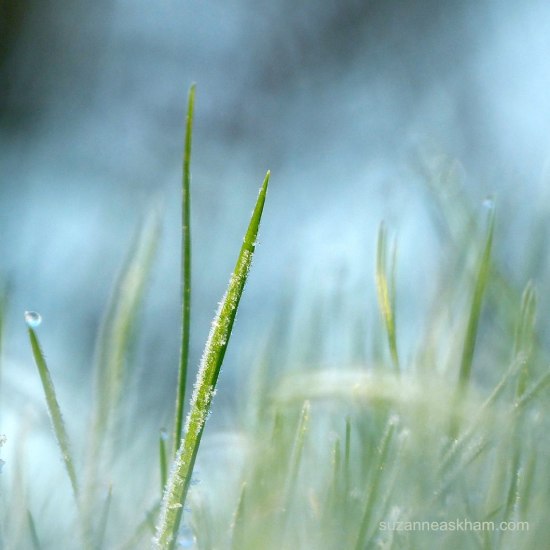
Here is a photo taken on a recent sunny, frosty day…
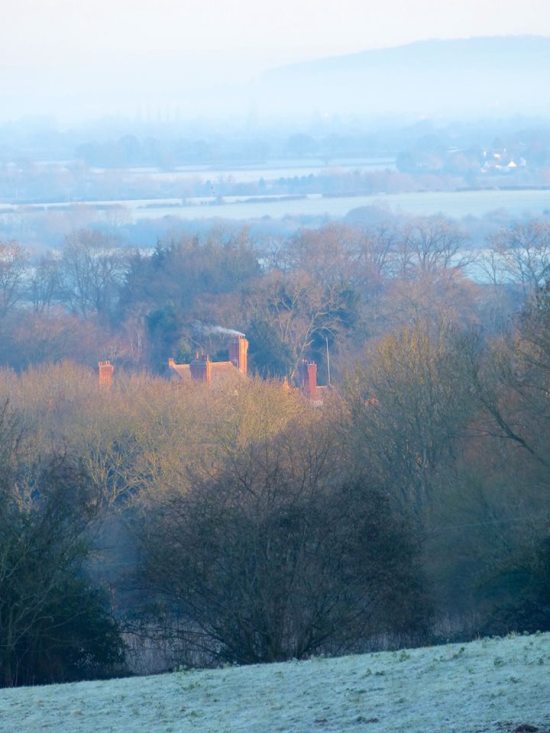
And here is another photo taken from the exact same spot…
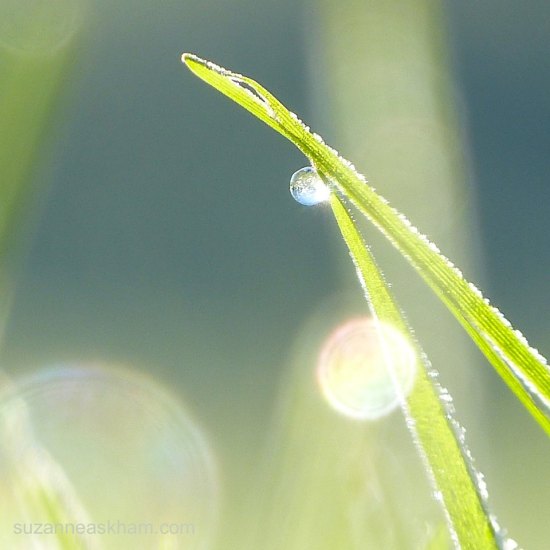
The only real difference between them is that in one, I decided to focus on the big picture. In the other, I zoomed into a tiny, beautiful detail.
Visualisation during meditation is exactly like that. We choose what to think about – focus on – in our mind’s eye. Then we close our eyes and reconstruct our chosen image in our mind.
It’s not always easy. Sometimes it can seem really hard. But if that’s the case, stick with it, as you are building up new ‘muscles’ in your mind. It gets easier with practice.
It helps a lot if you study a real image first…
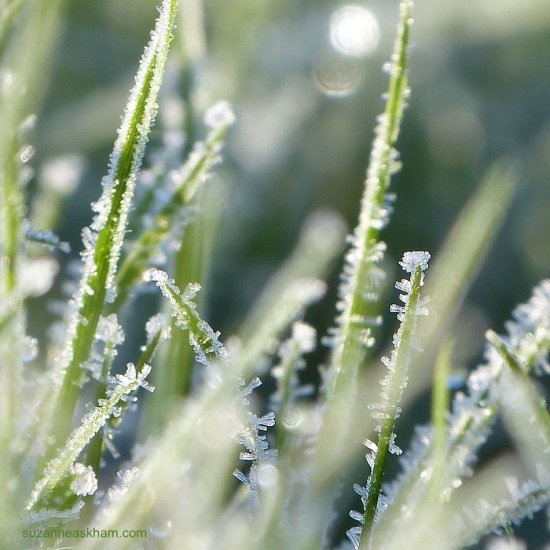
Notice all the tiny details that you can, then close your eyes and imagine them all over again. Pretty quickly, this process can feel calming and restful. This is the first gift of visualisation.
The second gift of visualisation is that you can use it to imagine things you’d like to have in your life. The rambling house in the country; the fulfilling work; the happy family….
Practise visualisation in meditation because it feels good, lowers your blood pressure, calms and revives you. Then, if you choose, practise visualisation with things you haven’t yet seen, but would like to. Imagine them as though they are as real and detailed as the images on this page. Allow meditative feelings of calm and happiness fill you as you do so.
In time, you will reduce the time you worry about what you don’t have, and increase the time you spend enjoying what you do have, which will encourage the good things to proliferate in your life, and increase your wellbeing, one meditative step at a time.
Website Built with WordPress.com.
Entries and comments feeds.
 Suzanne Askham