How to run a meditation group
11/05/2018 at 10:28 pm | Posted in Uncategorized | 5 CommentsTags: group work, healing, learning, meditation, Mind body spirit, Spirituality

“How do I go about running a meditation group?” This is a question I’m asked from time to time, so I thought it would be helpful to share a few guidelines. These are based on meditation groups I’ve run for nine years in Wiltshire, UK.
Consider yourself a facilitator, not a teacher
The members of any group will bring their own skills and experience to a session. Often, one person’s dilemma will be answered by another person’s insights. Your role is not to provide the answers, but to create the space in which answers arise from within the group. Often that means choosing a theme for the session, and being ready to ask gentle questions to encourage all members to contribute. You also keep the group on topic with your relevant questions. If you have particular experience of meditation, or teaching, those things are obviously very useful. But the most important skills to have are probably the willingness to turn up, and to do the best you can, by being properly prepared.
Decide the perfect time and place
Decide on a fixed day and time every week, fortnight or month. An hour is an ideal length of time for a session. This might include half an hour of silent meditation, followed by half an hour of discussion on the theme of the meditation. You also need to consider the venue. Many groups meet, at least at first, in the facilitator’s home. You then have to consider safety issues: who you are inviting into your home; and conversely, whether your home contains any hazards for unwary people. You may find it more practical to hire a local venue. Whatever you choose, look into what insurance may be required. And be consistent about finishing sessions on time.
Charge a fee
If a few friends are meeting in your living room it may seem hard to do this, but it really is a good idea to charge a small amount to cover expenses. You might spend money on refreshments, marketing, plus ancillary costs such as the provision of blankets to keep meditators cosy, or cleaning of the room. If you are hiring a hall, of course you need to charge enough to cover the cost of hire, refreshments, marketing and so on.
If you don’t charge a fee, your guests will begin to wonder if they owe you something. A fee evens things out. You are providing a service. The members are happy in the knowledge that they don’t owe you anything. You don’t develop the resentful feeling that you are doing something for nothing. A bowl on a table by the door with a fee marked beside it, and some change inside, is perfectly adequate. And if someone forgets to pay one week, don’t worry about it. It’s basically an honesty box, all part of the spirit of the gathering.
Set a timer
You will need to time your sessions. In silent meditation, it’s a good idea to use a timer to start a session, and to end it. A zen meditation timer, with chimes, is a nice way of doing this. I don’t especially recommend using a timer app on your phone. Although this is fine for solitary meditation, it lacks a certain ceremony, or ritual, that enhances group meditation.
Choose your method
You don’t have to follow a particular school of meditation. It’s essential, though, to come up with a format that feels right for you. The simplest format is this: Choose an uplifting word that lends itself to meditation. A word such as ‘Love’, ‘Peace’ or ‘Serene’ works well. Or you might chose an item from nature, such as ‘Leaf’, ‘Tree’, ‘Ocean’. The idea is that members of your group will sit still in silence, silently breathing in “I am” and breathing out the word. They might imagine the words are written in gold letters against a blue sky. Or they might picture, or sense, something that represents the word. The word itself – the theme – can be a new one for each session. You might, alternatively, keep the same word for a month, finding new insights every session. Encourage the members of the group to think of ‘I am’ as a collective force of the universe, rather than one person’s individual identity.
Offer a simple guided meditation
Optionally, you could guide them through the beginnings of the meditation: invite them to sit comfortably, close their eyes, become aware of their breath, their feet on the ground… invite them to visualise, or sense a peaceful scene that embodies the theme. Lead them to a period of silent meditation of 20 minutes. Set the timer at the beginning of the silence so that you can meditate fully yourself. When the timer goes at the end, you might offer a few words to lead them out of the meditation, or you might have pre-arranged that the meditation simply finishes at that point.
Singing bowl variation: instead of a timer, you could use a beautiful instrument such as a singing bowl to signal the beginning and end of the silent period. However, this does mean that you need to keep an eye on the time yourself, so this may potentially be less meditative for you.
Research your theme
Before each session, it’s helpful if you as facilitator have researched your theme. You might have learnt the earliest meaning of the word. You might have found a poem that evokes the theme beautifully. These are good things to share with the group. You might turn up with a useful meditative technique or an idea for a short guided meditation that you can share with others. You might share some easy meditation principles. Or give them a simple strategy for when they are too busy to meditate.
Be kind
Don’t put pressure on your guests, or expect them to do anything in particular. They are here to meditate, and that is all. You are the facilitator, the one who makes it happen. It is always wonderful to see who turns up on any particular week, and it’s good to see each meeting as perfect, just the way it is.
Be practical
The simplest of themes, focused on in a supportive atmosphere, can lead to emotional healing. Especially in the discussion that follows a period of silent meditation, an individual may become tearful. It’s helpful to follow these three guidelines for any group. And make sure tissues are always quietly available. At the same time, realise that you are not a counsellor (unless you are one, of course!) You are not there to mend anyone. If you feel out of your depth, you can very gently offer a suitable next step to a member of the group: they might visit their GP to ask for a referral for counselling, or some other strategy. In practice, it would be extremely rare for this to be necessary. The group supports each individual with compassion, empathy and humour. The humour itself is a natural part of any gathering, always to be welcomed.
Make sure everyone is well grounded before they leave. If need be, have them stamp their feet, or drink a glass of water. Say something spontaneous that gets people laughing. Talk about what they are doing later that day. Make time for a certain amount of small talk after the session has ended, while they are collecting bags and coats and shoes on their way out.
Keep a record
Keep a record of your themes, of the number of attendees, and of the small financial sums collected. You will need a record of your themes, in particular, to avoid too much repetition, and to gain an overview of how the group is developing.
Good luck
I hope these guidelines will be useful, but your group will be unique to you – and that’s the best way to be. Make decisions for your group based on love, rather than fear. Do things that make you feel joyful, and your group will surely thrive.
Make and meditate: mala beads
13/04/2018 at 12:55 pm | Posted in Uncategorized | 2 CommentsTags: energy healing, healing, mala, meditation, meditation inspiration, Spirituality
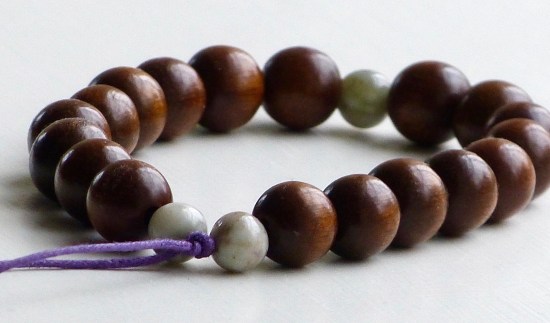
Meditating with beads is an ancient practice that spans many cultures. It’s particularly suited to current times because it releases us from technology. Apps and timers can be good meditation companions, but this is altogether a simpler method.
In this post, I’ll describe some of the basic types of meditation beads available, show you how to make the simple example above, and then show you a wonderful meditation practice.
The ready-made option
There are many ready-made items out there, which come at a price. Mala beads usually feature 108 beads, made from wood, seeds, ceramics or stone, sometimes with spacers. ‘Mala’ is an old Sanscrit word for ‘garland’. This one, bought from a Tibetan shop many years ago, is made from bodhi seeds from the same type of tree that the Buddha is said to have sat under when he experienced enlightenment.

Other meditation strings are much smaller. Twenty one beads is a common number, just the right size to wear around a wrist on an elasticated thread. This one, below, from thechakrastack, is made from fossilised wood. It features 20 beads, with additional metal beads as spacers.

How to make your own
It can be a meditation in itself to string your own beads. It’s also very inexpensive. You can source wooden beads, often made from furniture off-cuts, at many bead shops online. Look for sustainable sources.
The 21-bead string shown at the top of this post could be worn as a loose bracelet, but is designed primarily to be held during meditation. To make it, you will need the following:
70 cm x 0.5 mm waxed cotton thread
18 x 10 mm wooden beads
3 x 7 or 8 mm peace jade beads (or another crystal such as quartz, rose quartz, agate or amethyst)
A small amount of pvc glue
Method:
Dip the ends of your cotton thread into the pvc glue. Squeeze the ends between your fingers and allow to dry. (This hardens the ends and makes it easier to thread the beads.)
Thread 1 peace jade bead, then 9 wooden beads.
Repeat.
Finally, thread 1 peace jade bead.
Tie your strings securely together, as close to the beads as you can. The ideal is to end up with a bead bracelet that has just a small amount of movement possible between the beads. Cut off excess thread leaving around 3 cm.
How to meditate with your beads
Simply hold one bead between two fingers, breathe in and out at a leisurely pace, focusing on your breath, then move on to the next bead and repeat.
During the breath, it works well to focus on a particular word of your choice. The idea is that the word, or words you choose become seed thoughts, spreading their energy into every corner of your life.
With many meditations, it is recommended that you sit in a particular place, at a particular time. Here, I’m sharing a different method, that can help you create a happy day, and a peaceful night.
Morning seed word meditation
When you wake, sit up in bed, and hold your meditation beads. Think of two words that you would like to have permeating through your day. You might choose ‘love’ and ‘peace’, for example; or ‘simplicity’ and ‘joy’; or ‘abundance’ and ‘sharing’. For this demonstration, we’ll choose ‘love’ and ‘peace’.
Now, starting at the string ends, move your fingers onto one of the peace jade beads. Breathe in ‘love’ by saying it silently to yourself on the in-breath. Breathe out ‘peace’ by saying it silently to yourself on the out-breath. Move your fingers to the next beads, and repeat. Keep repeating until you have completed the circle and reached the threads once more. Then put your beads to one side, and get on with your day. Be aware of the energies of love and peace recurring throughout your day.
Evening seed word meditation
At night time, sit up in bed, and hold your meditation beads. Reflect on your day with a sense of love, gratitude and peace. Choose two words that will help you let go of the day. You might choose ‘love’ and ‘thank you’; or ‘gift’ and ‘rest’; or ‘serenity’ and ‘peace’. Then meditate with your beads, as in the morning seed word meditation above. Put your beads down by your bed, and rest.
This is the perfect time for your self care
12/02/2018 at 6:29 pm | Posted in Uncategorized | 2 CommentsTags: inspiration, Lent, mindfulness, personal development, reflections, self-care, Spirituality

Valentine’s Day and the first day of Lent coincide this year. The resulting fusion of love and abstinence from a selected item of food or drink makes this the perfect time to focus on self care.
How might you care for yourself for the 40 or more days of Lent, which begins this Wednesday 14th February?
One year ago, inspired by my friend Sarah Sexton, I gave up refined sugar for Lent. After Lent I continued the practice. I’m happy to say I am now 10 kg lighter, and back within a healthy weight range. Along the way I lost my sugar cravings, and the associated swings between high energy and tiredness.
Lent is a perfect time for self-reflection. On a scale of 1 to 10, how well are you currently caring for your body? What single act of food-abstinence will your body most benefit from?
Whatever your spirituality or lack thereof, approaching Lent as an act of self care is an invitation to thrive.
That wonderful feeling when your dream comes true
20/11/2017 at 8:24 pm | Posted in Uncategorized | 9 CommentsTags: dragons, energy healing, learning, meditation, poetry, reflections, Spirituality

At the beginning of this year I set myself a challenge: get some poetry accepted for publication. Today, that wish has come true. The Poetic Bond VII, an anthology edited by Trevor Maynard, features work by 50 poets from 11 countries. Together, they create a vivid snapshot of now. My three poems are set in England, New Zealand and infinity. They feature love, loneliness and yes, there are dragons. Quite a lot of dragons – the sort that can change lives. They’re worth getting to know!
Do go take a peek at Amazon UK or Amazon.com
What Westerners can learn from Eastern meditation
13/06/2017 at 10:00 am | Posted in Uncategorized | 4 CommentsTags: dhyana, inspiration, learning, meditation, mindfulness, reflections, relaxation, serenity, Spirituality, waterlily
When meditation goes well, it’s brilliant. Blissful. Calming. However many beginners struggle to reach that point. They talk about ‘failing’ and ‘not being able to meditate’, as though it’s an exam they’ve somehow flunked.
I’ve heard this despondent comment many times over the nine years that I’ve been running meditation groups in the UK. When newcomers turn up, they often say, “I can’t meditate, but I want to try and give it another go”. Or “I tried meditation once before, and I couldn’t do it.”
And, of course, I regularly meet people who wouldn’t go anywhere near a meditation group, believing that they are doomed to failure so it’s not even worth trying. But there’s something wistful in the way they tell me this. It’s as if they suspect they’re missing something, and they just don’t know what to do about it.
There is an interesting reason why Westerners may sometimes find it more difficult to meditate than their Eastern counterparts. It all comes down to the name itself: ‘meditation’. Or, to be exact, the origins of the name.
The Western approach
We can trace the verb ‘to meditate’ back to Latin. It meant: to ponder, reflect, consider, devise. In the old European languages it also meant: ‘to measure’, ‘to judge’, ‘to protect’, ‘to provide for’ and ‘to deliberate’. Go further back in time, to the original ‘seed’ language that early humanity shared, and it meant ‘to take appropriate measures’, ‘to give advice’ and ‘to heal’. This was the Proto-Indo-European (PIE) seed word, ‘med’, which also evolved into ‘mediate’ and medicine among other words.
The historical Western approach to meditation is therefore driven by a well-intentioned desire for results: the solving of a problem, the righting of a wrong, the mending of an ill.
The Eastern approach
In the East, the Sanskrit for meditation is ‘dhyana’. Other Eastern languages have variants on this. The PIE seed word for dhyana is ‘dheie’ meaning ‘to see, to look’. The word ‘Zen’, signifying an aspect of Buddhism with a deeply contemplative approach to life, shares the same seed word.
So in the East, ‘dhyana’ is the practice of simply being, simply witnessing without judgement.
Western meditators broadly follow the Eastern tradition. We sit in silence, simply being… but we also have a cultural legacy which whispers to us that we need to get results from our quiet time.
A happy fusion
Of course, we can’t really divide the world into neat East-West packages. Wherever you live, whatever your origins, you’re pretty well guaranteed to experience the ‘monkey chatter’ of your mind during meditation. And this can do a great job of distracting you with wide-ranging thoughts.
But your approach to the monkey chatter can make the difference between frustration and happiness during your practice – and that’s where an awareness of meditation’s ancient definitions can be helpful.
If we accept that we have chosen to sit in silence, focusing on a particular word, or concept, or image, or sound, simply to witness without trying to change anything, then we are much more likely to enjoy our meditation sessions. Each time we notice that our thoughts have strayed, we calmly remind ourselves that we are here to meditate, and we return to our point of focus.
No judgement. Just practice.
To summarise, we meditate simply to meditate. There is no end result we are looking for. So we cannot ‘fail’. We are simply being conscious witnesses of the moment.
And yet, when we make a regular practice of meditating in this way, with no expectation of reward, the insights and inspiration do come. Meditation focuses and refreshes the mind like nothing else.
So if you really struggle to meditate, take heart. You are not alone. Now that you know the ancient secret buried in the very name of meditation, you can choose to let go of the striving and, instead, embrace the serenity.
What sort of meditation do you do?
30/08/2015 at 10:01 am | Posted in Uncategorized | 4 CommentsTags: Dreams, Guidance, inspiration, meditation, nature, Spirituality

People often ask what sort of meditation we practise at the Studio. They expect to hear that we follow a particular school, be it Mindfulness, Christian, Vipassana, Transcendental or possibly following the teachings of a Buddhist leader such as Thich Nhat Hanh.
The truth is, we don’t follow any of these schools, although we do take an interest in them and are inspired by their insights. But our method is much simpler.
I call our practice ‘Intuitive Meditation’, because it came to me in a series of dreams and mystical experiences many years ago, around the time of the birth of my son, Tim. Readers of this blog will know that Tim was born with a complex set of health issues, and a happy, sociable and life-loving personality.
For a period of two years or more, before and after his birth, I experienced some intense dreams and waking visions. Through them I began to understand every human is a unique manifestation of the ‘All That Is’ – apparently separate, yet actually part of the whole.
One morning, as I woke up, I heard a simple yet beautiful song coming apparently from an invisible realm. It was sublimely uplifting. A mellow, male voice began each line with “I am…” Each verse had five lines, and the final line was always, “I am the Ocean”. The ‘O’ was long drawn out. The first four lines varied, but followed the same format:
“I am the land
I am the sea
I am the leaf
I am the tree
I am the ocean.’
The song faded away as I became fully awake. I was left with a sense of the beauty of nature, and the numinous insight that a unifying consciousness shines through all aspects of nature, including ourselves.
Immediately, I began to use the “I am” format in my own meditation practice. I would breathe in “I am” and breathe out a word from nature, or from our true nature. “I am leaf…” or “I am peace…” or “I am water…”. I would use one word for each meditation session.
The method was instantly calming and blissful. More than that, intuitive insights arose: it felt as though I was receiving invisible guidance to help me tread a sometimes difficult path.
Over many years, other people began to join me. Today, small groups of us gather in a hillside studio in North Wiltshire, where expansive views constantly remind us that natural beauty is in us and around us, and a subtle light shines through it all.
Let go of the brambles, and be still
02/08/2015 at 5:06 pm | Posted in Uncategorized | Leave a commentTags: Guidance, inspiration, meditation, personal development, poetry, Spirituality

Here is a poem by Sun Bu-er, renowned female teacher of Chinese Taoism, born 1124. I discovered it in Women in Praise of the Sacred edited by Jane Hirshfield:
Cut brambles long enough,
Sprout after sprout,
And the lotus will bloom
Of its own accord:
Already waiting in the clearing,
The single image of light.
The day you see this,
That day you will become it.
It can be such hard work to clear the sharp, knotted brambles and tangles that we metaphorically get into, and yet I think this poem is saying that light is present in all things. When we discover that, we become that light – or realise that we are already that light – and the effort falls away. What knotty problem do you currently face? And what would happen if you saw light shining in every aspect of the problem? Sometimes, letting go of effort is the quickest way to a solution, and to peace.
Spiritual: a quick definition
08/04/2015 at 4:27 pm | Posted in Uncategorized | 6 CommentsTags: chakras, inspiration, meditation, mindfulness, nature, peace, personal growth, self-awareness, Spirituality, wisdom

People often talk about being spiritual. Others deny that the spiritual realm even exists. But what does being spiritual actually mean? Here is a definition that works for me:
Beyond the levels of thinking and feeling lies pure consciousness, which we experience as pure love. Reaching this is spiritual transformation.
Once you’ve been there – really been there – you’ll always have it. It never goes away, although sometimes we manage to forget it for a while. However, we always remember sooner or later. It has a way of reminding us.
We get there by being fully present in the moment, and thus forgetting our ego-centred worries and desires. Looking at a beautiful aspect of nature – such as a flower, or a small child – can bring us to the shores of the spiritual realm. So, too, can a regular practice of meditation. Sometimes, this happens spontaneously, especially in those moments between sleep and waking. And it can also happen in extremis, when our ego-driven policies are no longer working for us, and we find ourselves yielding to a different, infinitely vaster view of the universe.

Next week a new, huge series of meditations begins in the Studio. Term by term, for seven terms, we’re going to focus on each of the main chakras – the energy centres that enable us to function in the physical realm, and also to develop our deeper understanding of life. This epic theme is designed to suit all levels of ability, and you can dip in and out as you wish. The intention is that we will focus ever more fully on the building blocks of our human psyche and our interface with the wider world.
This term, from now until July, we’ll be focusing on the base or root chakra, which is concerned with physical survival and manifestation. Join us whenever you can. And I hope you will experience the bliss of the spiritual, one word at a time.
Why ‘eternal’ is the new ‘now’
23/03/2015 at 6:25 pm | Posted in Uncategorized | 2 CommentsTags: Guidance, insight, inspiration, meditation, Mind body spirit, personal growth, self-awareness, self-development, Spirituality
 This week we’re focusing on the word ‘eternal’. It’s the final theme in our series, Adapting Mindfully to Change. The idea is that underlying the myriad worldly changes that we grapple with, there is a pure unchanging energy that we might call universal consciousness. It’s the realm of unity, and of our spiritual identity.
In this morning’s session the group was fizzing. The talk was of ‘rebooting’ after the global shift in energy from the Vernal Equinox, not to mention the recent solar eclipse, and the supermoon…. But then we did manage to sit in silence. We breathed in “I am” and breathed out “eternal”.
And that’s the thing. Simply doing this, and keeping on even though our minds are racing, does bring peace. It enables us to step off the hamster wheel of distracting thoughts and dramas.
In The Power of Now, Eckhart Tolle talks about having deep roots within – to connect consciously with our inner body, our essential energy. This is the essence of us that feels eternally young, however many calendar years we have. When we sit quietly with that energy, it is possible for the constraints of time to dissolve. We become fully present in the moment, aware that we are part of a blissfully soothing current of peace. If we look at our lives from the perspective of that peace, events appear like movies. We notice, almost lazily, that we don’t need to perpetuate the arguments and we can effortlessly forgive everyone, including ourselves, because actually there is nothing to forgive.
Tolle describes this as a divine reality. “What is God?” he writes. “The eternal One Life underneath all the forms of life. What is love? To feel the presence of that One Life deep within yourself and within all creatures. To be it. Therefore, all love is the love of God.”
We’re meditating on the word ‘journal’
05/03/2015 at 4:31 pm | Posted in Uncategorized | 2 CommentsTags: Guidance, innermost feelings, inspiration, journalling, meditation, Mind body spirit, parenting, personal growth, self-awareness, self-development, special needs, Spirituality
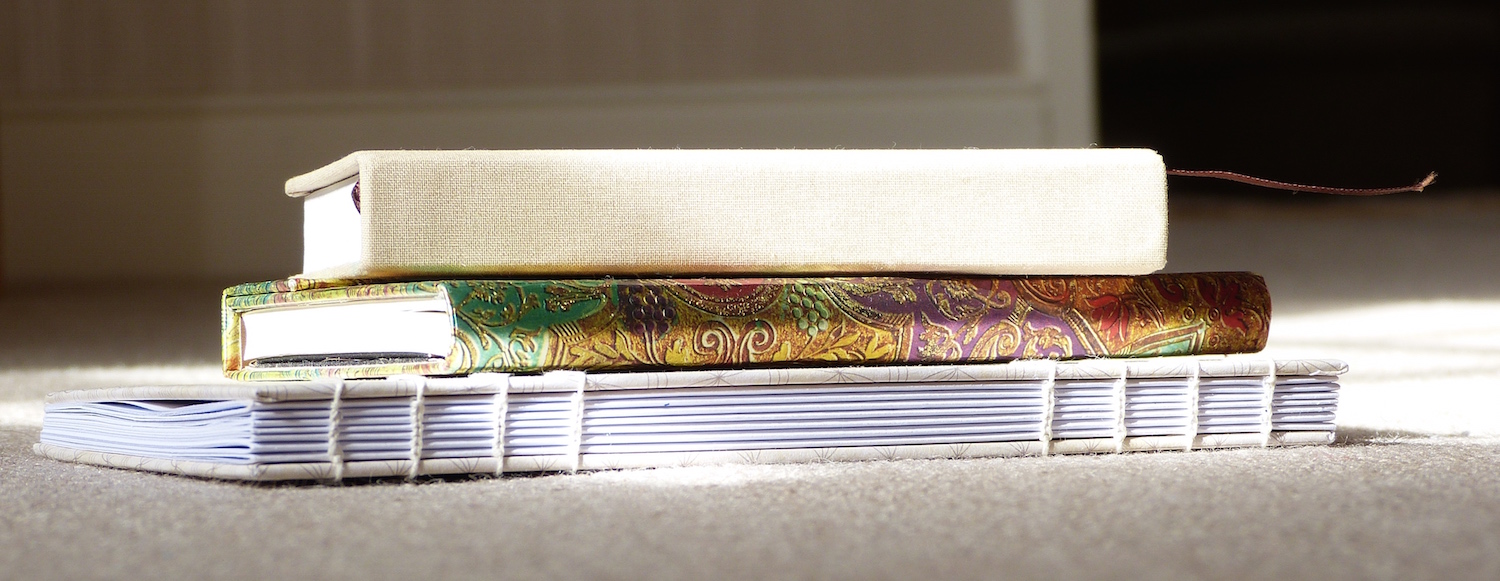
This week we’re meditating on the word ‘journal’. Many of us write journals. We love the act of buying a new notebook. There’s something gently intoxicating about the texture and scent of pristine pages. The writing itself is therapeutic. Often, it’s during the act of writing that we recognise how we actually feel. A journal, kept for decades, can even become a family heirloom.
And yet, even if we never put pen to paper, we are still recording life’s experiences, on the canvas of our own bodies. Habitual emotions are etched onto our faces through countless repetitions. Stored traumas alter the way we move our muscles and block the spontaneity of our movements. Happiness, in contrast, causes us to soften and glow. As Caroline Myss, author and speaker on human consciousness, has said, “Your biology becomes your biography.”
Meditating on the word ‘journal’ can be a challenge. We may not want to revisit the tricky times that are now indelibly recorded in book and body. Many of us would rather keep our life journals firmly closed. We may therefore feel resistance, even while we’re sitting still and trying to clear our minds.
However, there is a simple trick that can transform this meditation. I’d like you to picture, now, the brilliant white light that you can sometimes see emanating from a beautiful clear crystal, such as rock quartz. The light comes from a plane deep inside the crystal. Its beauty, shining from within, is a reminder of your own inner light. In your meditation, picture that light radiating from the pages of your journal, or from the canvas of your body.
It’s possible to see all of life’s events as though they were lit from within – with a soul light, if you like. From that perspective, it’s easier to recognise the gifts within a challenging experience, and also the new skills we’ve acquired from it, such as self-respect, wisdom and forgiveness.
Website Built with WordPress.com.
Entries and comments feeds.
 Suzanne Askham